
PIs: Noshir Contractor, Leslie DeChurch
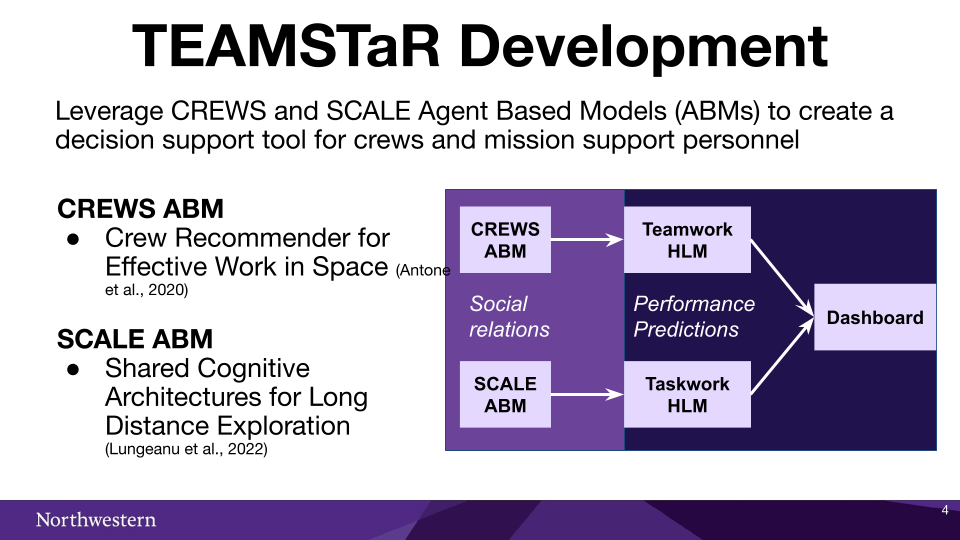
Project Summary: Team composition, or the configuration of team member attributes, is a critical leverage point for mitigating the risk of team performance decrements. NASA has successfully designed crews with “the Right Stuff” for more than fifty years beginning with the Mercury and Apollo programs throughout the Skylab and International Space Station missions. Whereas the “Right Stuff” emphasized the requisite individual characteristics, deep space missions also require the “Right Combination” of team members. The purpose of this project is to develop and validate TEAMSTaR, a team composition decision support system, that can be used by stakeholders (e.g., schedule decision makers) to predict how hypothetical team’s social relations are likely to evolve and influence crew performance over the course of a mission. Our research aims to: (1) refine agent-based models looking at relevant input characteristics and their ability to predict team outcomes, including team performance, (2) identify and elaborate the scientific rationale for attributes used within the model, identifying factors known to affect crew functioning, crew member behavior, emergent characteristics that arise during team task completion, (3) develop and validate a Team Composition decision support system and user interface, (4) validate the refined model using a software prototype in at least one extended duration, isolated and confined analog, and (5) provide modeling and software prototypes that meet NASA Standard 7009a. To address these critical aims, we propose a 3-year, multi-method research effort, in which we: (1) leverage insights and data from more recent NASA-funded team composition studies to extend our agent-based models; (2) conduct virtual experiments and gather stakeholder input to guide the development of TEAMSTaR, a team composition decision support system that utilizes insights from our updated ABM to enable decision-making, and (3) collect data in short-term and long-term isolated, confined, and controlled environment to validate TEAMSTaR.
Related work:
Chan, M., Sudarsan, S., DeChurch, L., Lungeanu, A., Bell, S., Contractor, N. (2025, Jan 28-31). Paired for Success: Operationally Building Crew Communication. [Poster Presentation]. NASA Human Research Program Investigators’ Workshop, Galveston, TX, United States.
Contractor, N., Chan, M., Lungeanu, A., DeChurch, L., Bell, S. (2025, Jan 28-31). TEAMSTaR: Supporting Resilient Teams to go the Distance. [Oral Presentation]. NASA Human Research Program Investigators’ Workshop, Galveston, TX, United States.
Qian, N., Chan, M., Lungeanu, A., DeChurch, L., Bell, S., Contractor, N. (2025, Jan 28-31). Improving Space Mission Success Through Team State-Building Activities. [Poster Presentation]. NASA Human Research Program Investigators’ Workshop, Galveston, TX, United States.
Ly, L., Chan, M., Lungeanu, A., DeChurch, L., Bell, S., Contractor, N. (2025, Jan 28-31). Evaluating the TEAMSTaR Dashboard: Usability Perceptions of Crew Members vs. Mission Control. [Poster Presentation]. NASA Human Research Program Investigators’ Workshop, Galveston, TX, United States.
Contractor, N. Lungeanu, A., DeChurch, L., Bell, S., Chan, M., Javalagi, A. (2024, Feb 13 – 16). TEAMSTaR: Supporting Resilient Teams to Go the Distance. [Poster Presentation]. NASA Human Research Program Investigators’ Workshop, Galveston, TX, United States.
Research supported by NASA Grant 80NSSC21K0925.
 Megan Chan