
Leslie DeChurch, Alina Lungeanu, Megan Chan, and Noshir Contractor
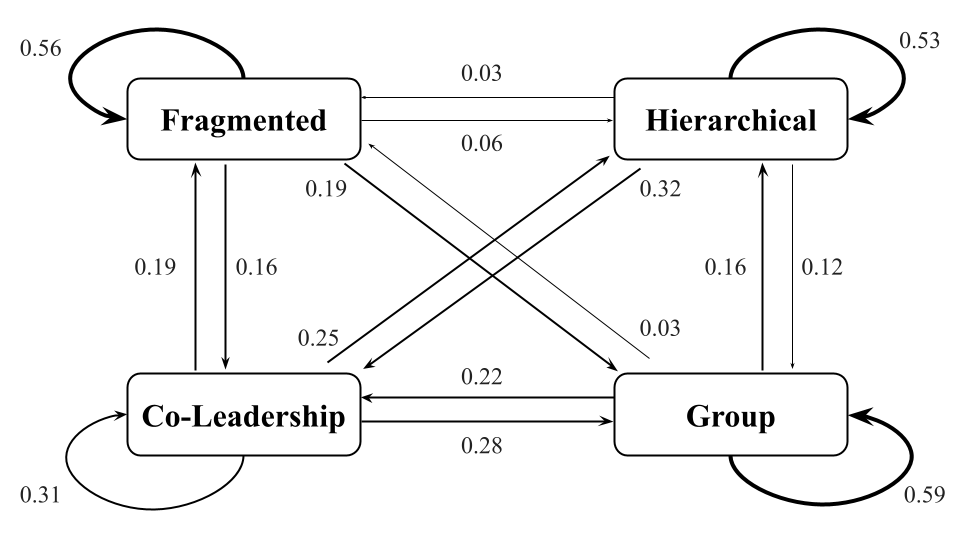
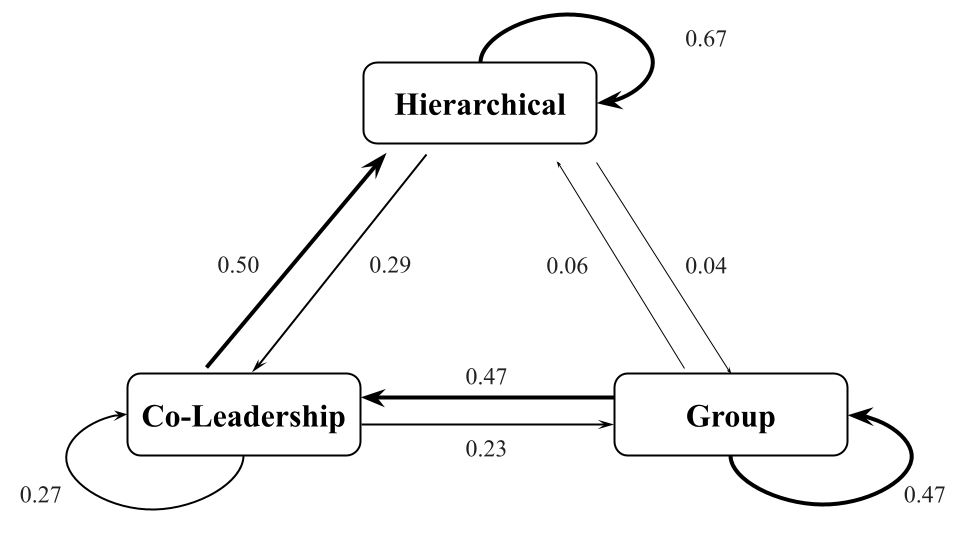
Abstract: Leadership research has established the benefits of shared leadership, but much less is known about its stability. Drawing on data from NASA space analog teams and Ancient Rome (32 BCE–491 CE), we discover that the number of leaders critically shapes whether shared leadership persists or changes form. Using observational data from 13 NASA crews and historiometric data from the Roman Empire, we find that shared leadership often arises in both contexts, but its stability varies markedly. Specifically, while both hierarchical leadership (single leader) and group shared leadership (three or more leaders) tend to persist, dyadic shared leadership (two leaders) is uniquely unstable. This “dyadic instability” appears consistently across modern and historical datasets, suggesting a recurring organizational phenomenon. These findings invite theorizing around mechanisms and boundary conditions that explain dyadic fragility and clarify when dyads versus larger constellations may be most effective. We outline coalition and polarization mechanisms and identify boundary conditions—self-organizing authority and complex task environments—under which dyadic fragility is most likely. Our results contribute to leadership theory by identifying a critical threshold in shared leadership arrangements and offer practical insights for organizations considering co-leadership models.
Related work:
DeChurch, L., Lungeanu, A., Chan, M., & Contractor, N. (2025). When Two is Too Many and Not Enough: Discoveries on the Stability of Shared Leadership from Rome to Mars. Academy of Management Discoveries.
DeChurch, L., Lungeanu, A., Chan, M. (2025, Jul 25-29). When Two is Too Many and Not Enough: Shared Leadership in Ancient Rome (32 to 491 CE). [Conference Presentation]. Academy of Management, Copenhagen, Denmark.
Winner of the Sage Publishers Award for best Management History Division paper in leadership
Research supported by NASA awards NNX15AM32G, 80NSSC18K0221, and 80NSSC18K0276
 Megan Chan